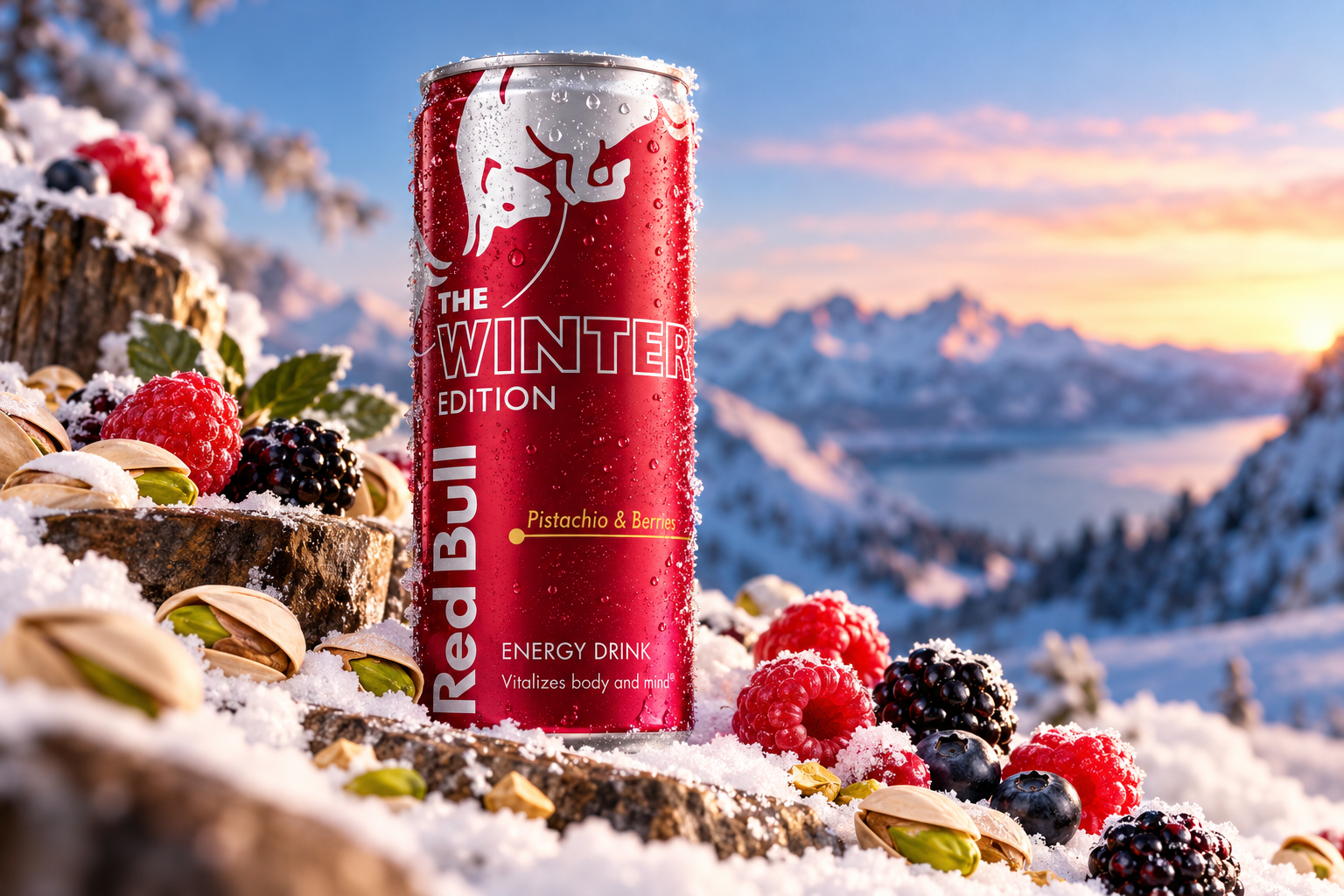
New Red Bull Flavor 2026: Pistachio & Berries Winter Edition Sparks Curiosity With an Unexpected Taste
FLAVOR NEWS | OCTOBER 25, 2026
Red Bull's new flavor for Winter 2026 is Pistachio & Berries, an unusual energy drink combining fruity berry notes with nutty, creamy, and caramel-like flavors. The limited-edition release represents a departure from conventional citrus and tropical energy drink profiles, introducing a dessert-inspired flavor experience that has attracted attention from beverage enthusiasts and industry professionals.
As searches for "new Red Bull flavor" gain attention, Pistachio & Berries is one of the most relevant recent launches. The drink arrived in UK retail channels on September 28, 2026, while American consumers are anticipating broader availability.
The development also highlights a larger beverage industry trend: manufacturers are increasingly experimenting with sophisticated flavor combinations that blur the boundaries between confectionery, desserts, and functional drinks.
Editorial note: The product announcements and availability details below are verified against published sources as of October 25, 2026. The reported search surge itself has not been independently quantified.
What Is the New Red Bull Flavor for 2026?
The latest Red Bull Winter Edition features Pistachio & Berries, combining the recognizable Red Bull energy drink foundation with an unconventional pairing of nut-inspired and fruit flavors.
According to Red Bull's official UK product description, the new beverage features pistachio and berries balanced by caramel, with creamy and nutty undertones.
This flavor architecture is especially interesting because pistachio is more commonly associated with ice cream, pastries, chocolate, and premium desserts than with carbonated energy drinks.
Berries, meanwhile, provide a familiar fruity flavor direction that can make the combination more approachable.
The result is a concept that promises both novelty and familiarity, appealing to adventurous consumers without completely abandoning traditional energy drink flavor expectations.
When Is Red Bull Pistachio & Berries Coming Out?
The Red Bull Winter Edition 2026 release schedule varies by market.
In the United Kingdom, the flavor initially appeared in a 473 ml format at Tesco on September 18, followed by broader retail availability on September 28.
According to Grocery Gazette's launch coverage, the drink is available in regular and sugar-free varieties, with multiple package formats.
In the United States, the situation is different. Red Bull has acknowledged the upcoming Winter Edition, but its official American availability FAQ does not establish a firm nationwide standalone release date.
However, the flavor has already been associated with the 2026 Red Bull Advent Calendar sold in the United States, giving some consumers early access.
While unofficial reports have suggested a November launch, consumers should distinguish those predictions from confirmed company announcements.
What Does Red Bull Pistachio & Berries Taste Like?
For flavor enthusiasts, the biggest question is how pistachio translates into a carbonated energy drink.
Based on the manufacturer's description, the flavor can be understood through four complementary sensory elements:
- Pistachio: Nutty, rounded notes associated with roasted nuts and premium desserts.
- Berries: Fruity character that may provide brightness and balance.
- Caramel: Sweet, confectionery-like notes that help connect the fruit and nut components.
- Creamy undertones: A smooth flavor impression that suggests richness without necessarily implying a dairy-based formulation.
From a sensory science perspective, the interaction between fruit acidity, sweetness, and nut-inspired flavors is particularly significant.
Berry character can counterbalance the heavier associations of pistachio and caramel, potentially making the drink feel refreshing rather than excessively dessert-like.
Importantly, these are interpretations of the stated flavor profile, not laboratory findings or a verified independent tasting panel.
An October 17 review from Sporked also provides an early consumer-oriented perspective on the product.
Ingredients, Caffeine, and Sugar Content
Despite its dessert-inspired flavor, Red Bull Pistachio & Berries retains the familiar functional energy drink ingredients.
According to the official Red Bull Winter Edition nutritional information, one 250 ml can of the regular UK version contains:
| Ingredient or nutrient | Amount |
|---|---|
| Caffeine | 80 mg |
| Sugar | 27 g |
| Energy | Approximately 113 calories |
| Taurine | Present |
| B vitamins | B3, B5, B6, B12 |
The sugar-free version also contains 80 mg of caffeine per 250 ml can, using sucralose and acesulfame K as sweeteners.
One noteworthy detail concerns allergens. Although the product tastes like pistachio, FoodBev Media reports that the drink does not contain nuts. Consumers with allergies should still review the labeling for their specific market.
Why Pistachio & Berries Matters to Flavor Professionals
Beyond consumer curiosity, this launch offers several insights into modern beverage flavor innovation.
First, it demonstrates the movement of premium dessert flavors into functional beverages. Pistachio has increasingly appeared in confectionery, bakery products, coffee, and other categories, making an energy drink application a logical but technically interesting extension.
Second, the formulation concept illustrates the importance of flavor balancing. Pistachio-inspired flavors often rely on roasted, creamy, and slightly sweet aromatic characteristics. In an acidic carbonated beverage, flavorists must consider how those characteristics interact with fruit flavors, sweeteners, and the drink's existing sensory profile.
Third, the pairing introduces an opportunity for layered flavor development. The berry character can deliver initial familiarity, while the nutty and creamy notes may contribute a more distinctive finish.
However, successful translation depends on sweetness management, aromatic stability, mouthfeel perception, and avoiding undesirable flavor interactions. These are formulation considerations, not confirmed details of Red Bull's proprietary recipe.
The commercial rationale is also notable. Research reported by FoodBev Media found that more than two-thirds of surveyed energy drink consumers aged 22–44 would consider trying a pistachio-flavored energy drink. The Red Bull-commissioned survey involved 252 consumers, so the results indicate potential interest rather than guaranteed sales.
What Are Consumers Saying About the New Flavor?
Early reviews suggest that Pistachio & Berries is distinctive but potentially divisive.
In its October 17 tasting, Sporked rated both the regular and sugar-free versions 7.5 out of 10.
The reviewer identified a recognizable mixed-berry character and subtle nuttiness, while noting that some unusual flavor notes might not appeal to everyone.
The sugar-free variant was also perceived as lighter and sweeter by the tasting group.
These early reactions underline a challenge facing unconventional beverage launches: novelty can stimulate initial trial, but consumer acceptance ultimately depends on delivering an enjoyable and repeatable drinking experience.
Red Bull's Broader Flavor Innovation Strategy
Pistachio & Berries follows several successful seasonal experiments.
Red Bull recently transformed its former Fuji Apple & Ginger Winter Edition into the permanent Red Bull Apple Edition, launched nationwide in the United States on August 31, 2026.
The company has also introduced a new Frosted Raspberry Glacier Edition in the UK, beginning October 12.
Together, these launches demonstrate how Red Bull uses seasonal editions to test new flavor territories, attract attention, and potentially identify candidates for permanent distribution.
For flavor houses, ingredient suppliers, and beverage developers, this approach reinforces the value of combining familiar flavor anchors with less conventional secondary notes.
Final Thoughts: Could Pistachio Become the Next Big Energy Drink Flavor?
The new Red Bull Pistachio & Berries Winter Edition is more than another seasonal beverage. It represents an experiment in bringing indulgent, dessert-inspired sensory experiences into the energy drink category.
For consumers, the appeal lies in discovering an unexpected combination of fruity brightness and creamy nuttiness.
For flavor professionals, the launch provides a compelling example of cross-category flavor innovation, sensory contrast, and the commercial potential of unusual taste combinations.
Whether Pistachio & Berries becomes a long-term favorite remains uncertain. But its introduction shows that the future of energy drink flavors may extend well beyond conventional citrus, tropical fruit, and berry profiles.
Red Bull's latest experiment raises an important question for the beverage industry: Could the next successful energy drink taste more like a premium dessert than a traditional energy drink?
Flavorist's Formulation Guide: Developing a Pistachio & Berries Energy Drink Inspired by Red Bull Winter Edition 2026
Technical formulation brief | Beverage flavor development | October 2026
Red Bull's new Winter Edition Pistachio & Berries provides an interesting formulation challenge: creating a refreshing, acidic, carbonated energy drink that delivers recognizable nutty, creamy, caramel, and berry notes without tasting like a heavy dessert.
Based on Red Bull's published product description, ingredient declarations, and nutritional information, flavorists can develop an experimental flavor system with similar sensory characteristics.
The following recommendations are an independent reverse-engineering hypothesis, not Red Bull's actual formula. The proposed percentages, flavor chemicals, dosages, and processing conditions are experimental starting points that require validation.
1. Establish the sensory target
Red Bull officially describes its Winter Edition as featuring pistachio and berries, balanced with caramel and nutty, creamy undertones (Red Bull).
This suggests the following sensory profile as a working hypothesis:
| Sensory dimension | Target profile | Relative intensity (1–10) |
|---|---|---|
| Mixed berries | Juicy, red-fruit, mildly tart | 8 |
| Pistachio | Roasted, nutty, subtly sweet | 6 |
| Creaminess | Soft, rounded, dairy-like perception | 4 |
| Caramel | Light cooked sugar, buttery sweetness | 3 |
| Acidity | Bright, refreshing, clean | 7 |
| Lingering sweetness | Medium, with a confectionery finish | 6 |
Hypothetical sensory targets, not measured Red Bull data.
The formulation objective should be a bright berry opening followed by a distinctive pistachio mid-palate, finishing with restrained cream and caramel.
A key principle is to build pistachio character using aroma chemistry rather than relying on actual pistachio paste or oil, which may introduce emulsification, oxidation, sedimentation, and allergen-management challenges.
2. Design the pistachio flavor accord
Pistachio flavor is complex. A convincing beverage-compatible accord should combine roasted-nut, sweet-almond-like, fatty, creamy, and light green-nut nuances.
The following materials may be useful:
| Flavor material | Sensory role | Development guidance |
|---|---|---|
| Benzaldehyde | Sweet almond, nut kernel | Use sparingly; excessive amounts produce a marzipan or cherry impression |
| 2-Acetylpyrazine | Roasted nuts, toasted cereal | Use trace levels for authentic roasted complexity |
| 2,5-Dimethylpyrazine | Roasted, warm, nutty | Adds supporting depth |
| Acetoin | Buttery, creamy | Softens the nut accord |
| Gamma-nonalactone | Creamy, fatty, coconut-like | Use sparingly to avoid a tropical or coconut direction |
| Maltol | Caramel, cooked sugar | Bridges pistachio and sweet berry notes |
| Ethyl maltol | Sweet, candyfloss, caramel | Use low levels to avoid candy-like sweetness |
All these materials must be assessed for food-use authorization, specifications, maximum permitted exposure where applicable, and suitability for the intended market.
Suggested approach
Begin with a commercial, beverage-grade pistachio flavor as a reference. Evaluate it in a citric-acid solution at the intended finished-drink pH, rather than judging it only in water.
Develop three variants:
- P1 — Fresh pistachio: Lower pyrazine intensity, slight green and almond-like character.
- P2 — Roasted pistachio: Stronger roasted-nut emphasis supported by pyrazines.
- P3 — Creamy pistachio: More rounded, lactonic, softly caramelized finish.
P2 and P3 are logical starting candidates because the official product description explicitly emphasizes creamy and nutty undertones.
3. Build a mixed-berry top note
The berry accord should provide the initial recognizable flavor impact and counterbalance the richer pistachio notes.
A reasonable first hypothesis is a combination of raspberry, blackberry, and blueberry characteristics, although Red Bull has not publicly identified these as the specific berries used.
| Berry character | Proposed role |
|---|---|
| Raspberry | Bright, recognizable red-berry top note |
| Blackberry | Dark, juicy body and slight jammy richness |
| Blueberry | Rounded berry sweetness and softer finish |
Potential building blocks include:
- Raspberry ketone, appropriately diluted, for ripe raspberry nuances.
- Selected fruity esters for lift and juiciness.
- Beta-ionone in very small quantities for violet, berry, and floral depth.
- Furaneol, when appropriate, for cooked-fruit and caramelized strawberry nuances.
- Commercial berry flavor fractions for more realistic top-note complexity.
Do not interpret the mere presence of these materials as evidence that Red Bull uses them.
4. Develop an experimental flavor concentrate
The following is a 100% w/w conceptual blending formula using commercial flavor accords or pre-diluted flavor solutions, not neat high-impact aroma chemicals.
Prototype flavor concentrate — Formula PB-01
| Component | Weight % |
|---|---|
| Raspberry flavor accord | 24.0 |
| Blackberry flavor accord | 16.0 |
| Blueberry flavor accord | 9.0 |
| Pistachio flavor accord | 28.0 |
| Creamy flavor modifier | 7.0 |
| Caramel flavor accord | 4.0 |
| Mild roasted-nut modifier | 2.0 |
| Compatible flavor carrier | 10.0 |
| Total | 100.0 |
These are blend ratios, not finished-drink percentages. They assume standardized, beverage-grade commercial accords and cannot be safely or reliably applied to neat individual aroma compounds.
Start at 0.08–0.12% of concentrate in the finished beverage, subject to the suppliers' recommended use levels and safety specifications.
Pilot-batch sizing
Use the weights below to size the conceptual flavor blend for laboratory development. Example for 100 g of flavor concentrate:
| Ingredient | Mass (g) |
|---|---|
| Raspberry accord | 24.00 |
| Blackberry accord | 16.00 |
| Blueberry accord | 9.00 |
| Pistachio accord | 28.00 |
| Creamy modifier | 7.00 |
| Caramel accord | 4.00 |
| Roasted-nut modifier | 2.00 |
| Flavor carrier | 10.00 |
Assumes formulation by mass. The finished batch size includes the concentrate. These figures do not establish ingredient regulatory clearance.
5. Construct the beverage base
The published ingredient listing for the regular UK version includes water, sucrose, glucose, citric acid, carbon dioxide, taurine, sodium citrates, caffeine, B vitamins, flavorings, caramel color, and riboflavins (Heron Foods).
For initial flavor development, use a simplified, non-caffeinated beverage base. This allows the flavorist to evaluate aroma balance without caffeine bitterness or vitamin-related off-notes.
Suggested starting base for a 1 kg pilot
| Ingredient | Experimental target |
|---|---|
| Sucrose | 75 g |
| Glucose/dextrose, expressed as sugar solids | 33 g |
| Citric acid | 2.0–3.0 g |
| Sodium citrate | 0.3–0.7 g |
| PB-01 flavor concentrate | 0.8–1.2 g |
| Purified water | To 1,000 g |
| CO₂ | Carbonate separately, to target |
The 108 g combined sugar target per kilogram is chosen to approximate the declared sugar level of around 11 g per 100 ml; it is not the disclosed sucrose-to-glucose ratio.
Recommended experimental targets:
- pH: 3.0–3.4, with 3.2 as the initial screening target.
- Soluble solids: approximately 10.5–11.5 °Bx, adjusted based on measurement.
- Carbonation: approximately 2.5–3.0 volumes CO₂ for pilot evaluation.
These acidity and carbonation values are development assumptions, not confirmed Red Bull specifications. Final acid additions should be controlled by measured pH and titratable acidity.
For subsequent comparison with a functional energy drink matrix, the published Red Bull product includes taurine at 0.4% and caffeine at approximately 0.03% (Bestway). These should be introduced only in a separately reviewed functional-beverage prototype, using appropriate regulatory, toxicological, and quality controls.
6. Conduct a controlled flavor optimization experiment
Instead of trying to perfect a single formula immediately, produce a small design-of-experiments matrix.
The most important variables are berry-to-pistachio balance, creaminess, sweetness, and acidity.
| Trial | Berry emphasis | Pistachio emphasis | Target outcome |
|---|---|---|---|
| A | High | Low | Bright and refreshing |
| B | Medium | Medium | Balanced benchmark |
| C | Low | High | Richer nutty character |
| D | High | High | Stronger total flavor impact |
| E | Medium | Medium, with elevated creaminess | Dessert-inspired finish |
Maintain constant total flavor addition across trials when comparing their aromatic balance.
Evaluate each sample for aroma before tasting, initial flavor impression, pistachio recognition, berry authenticity, aftertaste, sweetness-acidity balance, and overall preference.
Where possible, include an actual commercial Pistachio & Berries sample as a blind reference. Without this direct sensory comparison, resemblance to the Red Bull product remains speculative.
7. Correct common formulation problems
| Problem | Likely cause | Recommended correction |
|---|---|---|
| Tastes like cherry-almond syrup | Excessive benzaldehyde-like notes | Reduce almond character; reinforce roasted-nut complexity |
| Pistachio disappears | Berry top notes dominate | Increase pistachio accord or reduce berry intensity |
| Too much roasted-cereal character | Excessive pyrazines | Reduce roasted modifiers |
| Tastes like candy | Excessive ethyl maltol or confectionery notes | Reduce sweet aroma modifiers |
| Creamy notes feel incompatible with acidity | Excessive buttery or lactonic flavor character | Reduce creamy modifiers; increase clean berry top notes |
| Unpleasant bitter finish | Flavor interactions, caffeine or other matrix components | Evaluate each ingredient separately in controlled trials |
| Haze or surface ring develops | Inadequate flavor solubility or emulsion stability | Reformulate the delivery system and test in the final beverage matrix |
For a clear carbonated energy drink, prioritize water-compatible flavor systems and assess appearance after chilling, carbonation, and storage.
8. Validate processing and shelf-life performance
Once the sensory profile is promising, conduct stability trials in the actual beverage matrix.
Recommended checks include refrigerated, ambient, and elevated-temperature storage, with sampling at initial, 2-week, 4-week, 8-week, and 12-week intervals for pilot screening.
Monitor pH, flavor intensity, off-note development, sedimentation, haze, color changes, and packaging interactions. Accelerated testing is useful for screening but does not replace validated real-time shelf-life studies.
The finished formulation also requires appropriate microbiological validation and a commercially suitable manufacturing process. Beverage emulsions must be assessed after dilution into their intended matrix, not only as stable concentrates (flavorist.com).
Before commercial use, confirm each material's regulatory status, conditions of use, allergen declarations, and applicable labeling requirements. The FEMA flavor safety guidance and FDA food-substance inventory provide useful reference points.
9. Recommended development direction
Flavorists might want to prioritize a berry-forward pistachio flavor with a creamy, lightly caramelized finish, rather than a strongly roasted or marzipan-like pistachio character.
The most promising formulation would likely deliver:
- An immediate juicy raspberry/blackberry impression.
- Recognizable pistachio during the middle of the tasting experience.
- Subtle creamy-caramel notes that connect the berry and nut flavors.
- Clean acidity and carbonation that restore refreshment after swallowing.
The crucial challenge is to achieve sufficient pistachio recognition without allowing the profile to become heavy, oily, or confectionery-dominated.
Final formulation recommendation: Use PB-01 as the first sensory screening concentrate, compare it against berry-forward and pistachio-forward variants, and optimize within the finished acidified, carbonated beverage matrix. Direct comparison with a commercial reference, ideally supported by descriptive sensory analysis and instrumental volatile profiling, is essential before making any claim of close flavor matching.
This framework should give professional flavorists a practical starting point for developing an original Pistachio & Berries energy drink inspired by the new Red Bull Winter Edition, while clearly separating confirmed product information from experimental formulation hypotheses.